
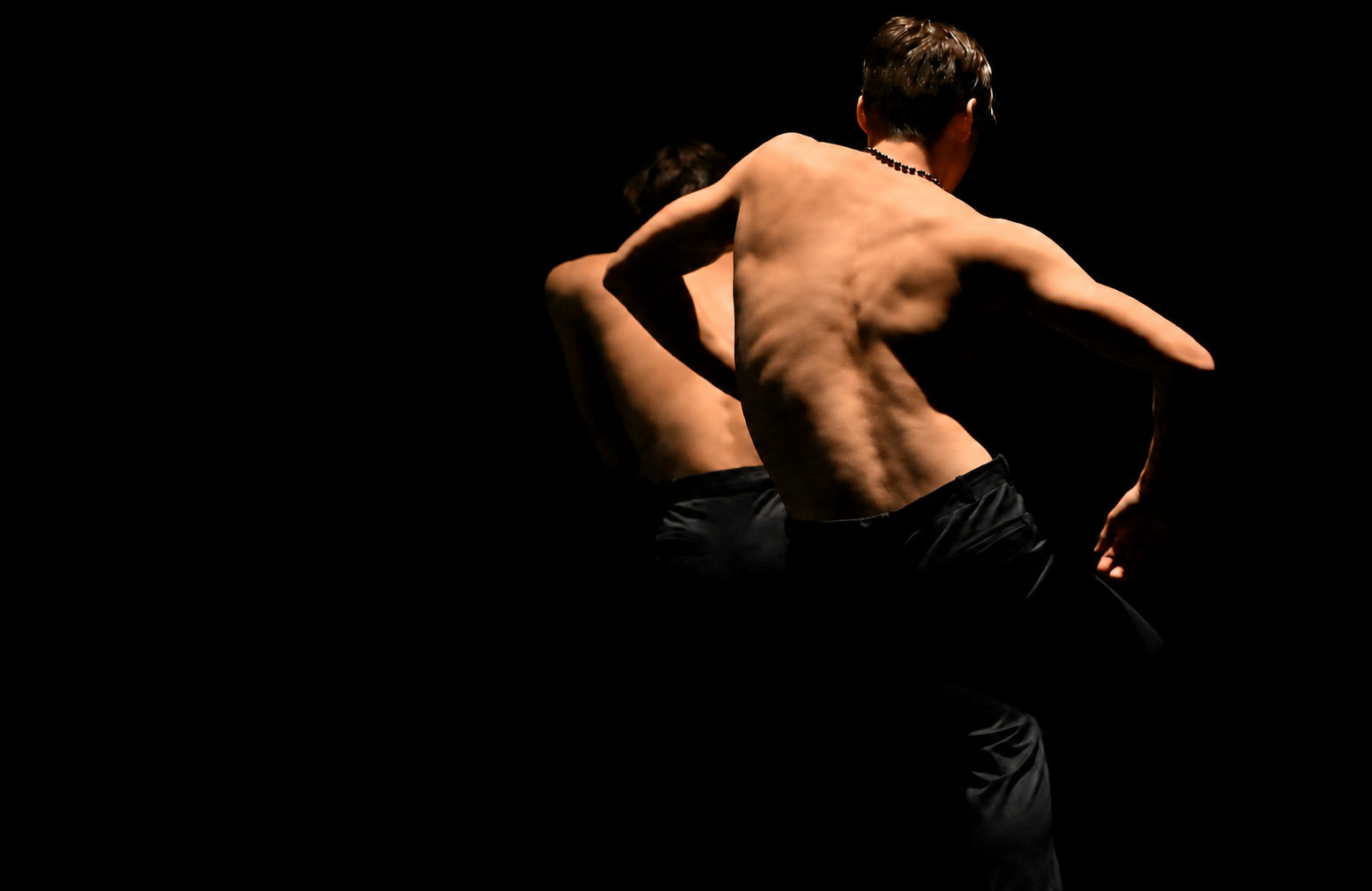
YEAHH d’Hélène Blackburn/Cas Public ©Bernard Brault
From September 9 to 19, the 24th edition of Festival Quartiers Danses (FQD) will take place in venues and neighborhoods across Montreal. In addition to showcasing the work of some 30 artists from here and abroad, this edition will mark the departure of its founder, Rafik Hubert Sabbagh. After 24 years at the helm of this event, he is handing the reins to its three-member artistic committee: Kyra Jean Green, Charles Brécard, and Pauline Gervais.
“The festival allowed me to create my first show in a professional setting and gave me a lot of confidence to launch my career as a choreographer and performer,” recalls Pauline Gervais, who has since participated in the FQD seven or eight times since graduating from the École supérieure de ballet du Québec in 2017.
Alongside her artistic career, Pauline has always had an interest in cultural management. In 2023, she joined the Festival’s team, first as communications coordinator and then, shortly thereafter, on the artistic committee. “I’ve always loved seeing the work of other choreographers—it’s always inspired me. But now, going to see shows with the specific goal of programming the next edition—I love that!” she says.
So it was Rafik Hubert Sabbagh, Kyra Jean Green, Charles Brécard, and she who put together the last three editions of FQD. “We’ve figured out what works well and what’s effective when we work together. We carefully review the applications and then prioritize our top picks first. Above all, we discuss the proposals and make sure they complement each other, come from a wide range of backgrounds, and span the spectrum from the most classical to the most performance-oriented. The idea behind the festival is to give artists of all styles a chance,” she explains.
This was indeed Rafik’s vision when he first considered launching a festival in Montreal. “My goal was to showcase Montreal’s cosmopolitan spirit and highlight all styles of contemporary dance, including works by today’s choreographers,” he says.
Another important point for professional dancers: making dance accessible. “It’s essential to have access to culture. Why? Because it helps you grow, deepen your understanding, and reflect. You see a girl crying on stage or in pain, or, on the contrary, someone who’s joyful—you, too, experience those kinds of moments! It speaks to you because you’re human; you’re normal. Art humanizes people—that’s important,” he explains. This is a unique aspect of the festival that the artistic committee particularly appreciates. “Rafik had to work hard to help people understand the appeal of outdoor dance,” adds Pauline. “But giving people the chance to see dance—by chance or on their way home from work—is important. Outdoors, we reach new audiences, perhaps those less accustomed to it, and it also brings new forms of dance.”
Over its 24-year history, FQD has evolved and, according to its founder, has become “stronger than ever.” “The Festival is now internationally recognized; we have between 25 and 30 presenting organizations each year, and in total, we’ve held more than 3,500 cultural outreach workshops.” “In over 20 years, I’ve put about 30 artists ‘on the map,’” says Rafik.
Although he’s been thinking about stepping down for several years, it wasn’t until this year that FQD director made the big decision. “The festival isn’t looking to get bigger, just to consolidate its position even further. I have confidence in my artistic committee and hope it will continue with the same vision, while allowing the festival to evolve in its own way,” he says.
For Pauline, the excitement is palpable. “We’re fortunate to be building on the solid legacy Rafik leaves us—the dance community, the team, the audience, and so on. FQD’s roots are deeply established and strong. They’ve proven their impact and importance in Montreal,” she concludes. “A younger voice will be able to take on a greater role in the festival, build on what already exists, and see how it can evolve—without losing sight of the festival’s mission. It’s exciting to see what’s coming and the new direction the festival will take!”